
Running a Darknet Market in 2026 – Why the Risk Is Higher Than Ever
Sep 03, 2026
There was a period when darknet-market administrators sometimes appeared almost untouchable. A hidden service could operate behind Tor, accept cryptocurrency and connect thousands of anonymous buyers and vendors without revealing the physical location of the marketplace.
More than a decade of darknet investigations has changed that picture considerably. Silk Road, AlphaBay, Hansa, Wall Street Market, Kingdom Market, Nemesis, Bohemia, Incognito and Archetyp are only some of the major markets that have disappeared following law-enforcement action.
The important difference today is experience. Police agencies are no longer learning how darknet markets operate from scratch. Investigators have spent more than a decade studying their infrastructure, financial systems, administrators, vendors and users. Evidence collected from one marketplace can even help investigations continue long after that particular market has disappeared.
Tor Isn't a Magic Invisibility Cloak
Tor remains powerful privacy technology. It can conceal the physical location of a hidden service and make ordinary internet surveillance considerably more difficult. But hiding a server isn't the same thing as making an entire criminal organization invisible.
A successful darknet marketplace can involve administrators, moderators, vendors, customers, cryptocurrency transactions, messages, disputes and physical packages moving through postal networks. Each additional part of that ecosystem potentially creates another source of evidence.
This is why police don't necessarily have to “break Tor” to dismantle a darknet market. Instead, investigators can target the organization surrounding the hidden service. A vendor might be arrested, a server could be seized, cryptocurrency could be traced or confiscated, packages could be intercepted, or evidence obtained during another marketplace investigation could produce new leads.
The website may exist inside Tor, but the people and activity surrounding it don't necessarily remain hidden forever.
Cryptocurrency Investigations Have Changed
Early darknet markets also benefited from the widespread belief that Bitcoin was anonymous. We now know that description is misleading.
Bitcoin uses a public blockchain, meaning transactions remain permanently available for analysis. Investigators and blockchain-analysis companies can examine historical movements of cryptocurrency and sometimes combine that information with evidence obtained elsewhere.
The permanence of blockchain records creates an unusual problem for criminals. Investigators don't necessarily have to understand every transaction when it happens. Historical transactions can potentially become more useful years later when another wallet, exchange account or individual becomes identifiable.
Privacy-focused cryptocurrencies such as Monero make blockchain analysis considerably more difficult, but cryptocurrency is only one component of a darknet investigation. Authorities can combine financial evidence with seized servers, communications, devices, postal evidence and traditional investigative work.
Old Market Data Can Continue Producing Arrests
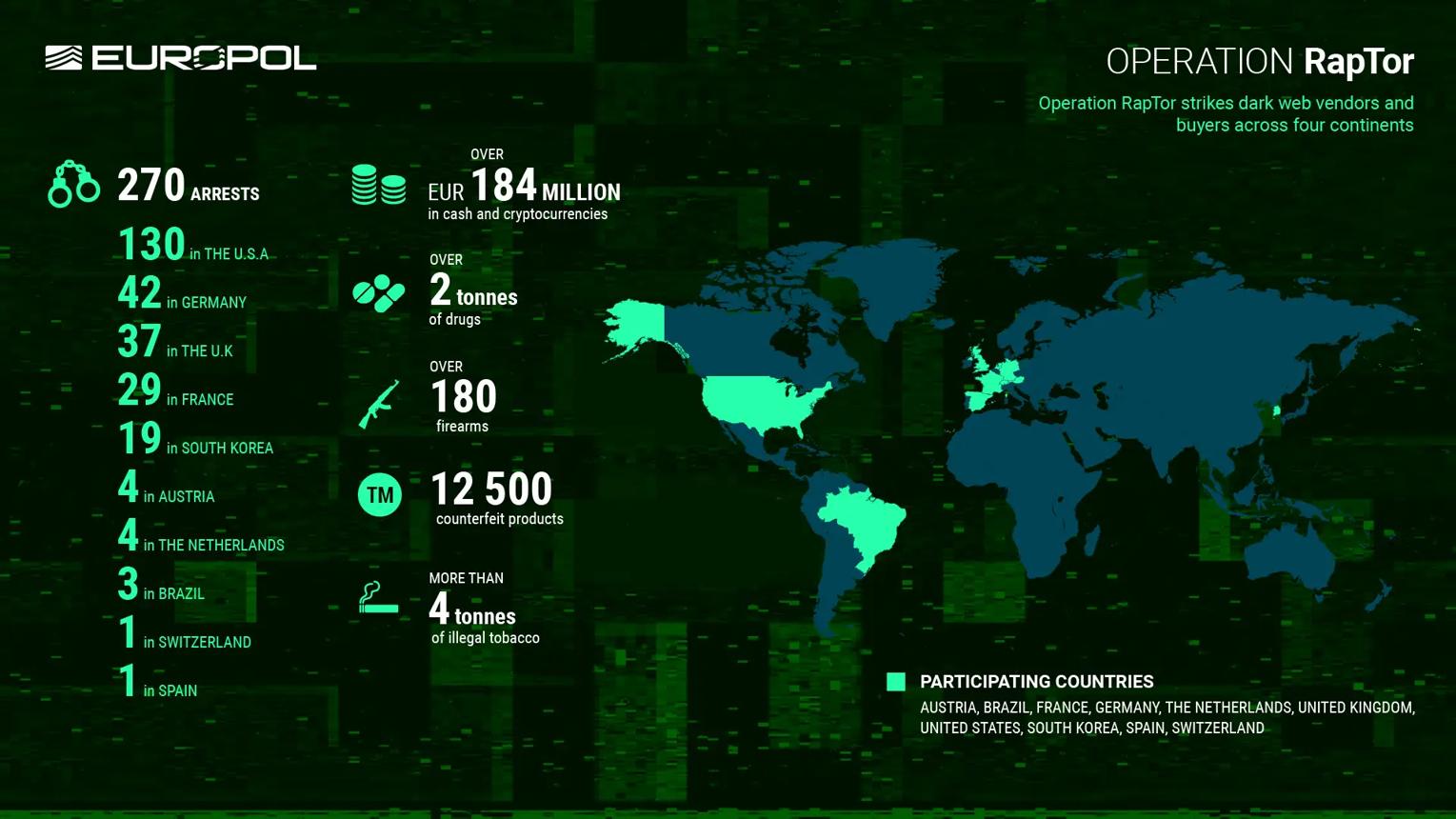
One of the clearest demonstrations of modern law-enforcement capabilities came with Operation RapTor in 2025.
Authorities announced 270 arrests across ten countries and seized more than $200 million in currency and digital assets, along with more than two metric tons of drugs and over 180 firearms.
What made the operation particularly interesting was where some of the intelligence originated. Authorities said investigations benefited from information gathered following the takedowns of darknet marketplaces including Nemesis, Tor2Door, Bohemia and Kingdom Market.
In other words, shutting down a marketplace doesn't necessarily conclude the investigation. Seized information can continue generating leads against vendors and other participants months or even years later.
That changes the risk calculation considerably. Someone may watch a marketplace disappear, see that they weren't immediately arrested and assume the danger has passed. In reality, investigators may still be examining information obtained from the platform.
Archetyp Market: Five Years Didn't Make It Untouchable
Archetyp Market provides another important example.
By 2025, Archetyp had survived for more than five years, an unusually long lifespan for a major darknet marketplace. Europol said the platform had accumulated more than 600,000 users, over 17,000 listings and at least €250 million in transaction volume.
Its longevity might have created the impression that its security was working.
Then, in June 2025, approximately 300 officers participated in coordinated operations across Europe. The alleged administrator was arrested in Spain while moderators, vendors and technical infrastructure were targeted elsewhere.
Authorities from Germany, the Netherlands, Spain, Sweden and Romania participated in the operation.
The Archetyp case illustrates one of the paradoxes of running a darknet market: surviving longer can make a marketplace more profitable, but it also gives investigators more time to build a case.
Success Can Become the Administrator's Biggest Problem
A small marketplace and a platform processing hundreds of millions of euros are very different law-enforcement targets.
As a market grows, it attracts more vendors, customers and money. That can also mean more investigations, more seized packages, more arrested vendors and more countries becoming interested in the organization.
The administrator sits at the center of that expanding ecosystem. Depending on how a market operates, administrators may be connected to infrastructure, moderators, disputes, commissions and the financial operation of the platform.
Success therefore becomes a double-edged sword. More transactions can generate more revenue, but they can also generate more potential evidence and attract increasingly sophisticated investigators.
A major international darknet marketplace may eventually attract attention from organizations such as Europol, the FBI, DEA, Homeland Security Investigations, customs agencies, national cybercrime units and financial investigators simultaneously.
Incognito Market Shows How Serious the Consequences Can Become
Incognito Market became one of the world's largest darknet narcotics marketplaces. U.S. prosecutors said the platform accumulated more than 400,000 buyer accounts and approximately 1,800 vendors, facilitating over 640,000 transactions involving more than $105 million in illegal drugs.
Its operator, Rui-Siang Lin, operated under the online identity “Pharaoh.”
Incognito disappeared in 2024, but Lin was subsequently arrested. In February 2026, a U.S. federal court sentenced him to 30 years in prison and ordered the forfeiture of approximately $105 million.
The case demonstrates the enormous difference between the apparent rewards of operating a successful market and the consequences if the administrator is eventually identified.
Closing the Market Doesn't Necessarily End the Risk
Dream Market demonstrates another danger: time.
Dream was one of the longest-running major darknet markets, operating from 2013 until its closure in 2019. For years afterward, the identity of its alleged main administrator remained uncertain.
Then, in 2026, German authorities arrested Owe Martin Andresen, whom U.S. prosecutors accuse of operating Dream under the administrator identity “Speedstepper.”
According to prosecutors, investigators followed cryptocurrency connected to old Dream Market administrator wallets after funds began moving years after the marketplace had closed.
Kingdom Market provides another example. The market was seized in 2023, but legal consequences continued afterward. In May 2026, administrator Alan Bill was sentenced in the United States to 200 months in prison.
Cases like these demonstrate why simply shutting down a marketplace and disappearing isn't necessarily enough to make an investigation disappear with it.
International Cooperation Has Become Much Stronger
International borders once created enormous difficulties for cybercrime investigations. They still create legal and practical challenges, but cooperation between countries has become far more routine.
A darknet administrator may live in one country while infrastructure is located in another. Vendors can operate across dozens of jurisdictions and customers can be scattered around the world.
Instead of one country attempting to investigate everything, different agencies can contribute separate pieces of the same case. Europol and Eurojust frequently coordinate European investigations, while agencies such as the FBI, DEA and Homeland Security Investigations work alongside national police, customs and financial investigators.
Archetyp demonstrated this clearly, with coordinated action across several European countries. Operation RapTor went even further, involving authorities across multiple continents.
For somebody operating an international darknet marketplace, geographic borders therefore provide much less comfort than they once might have.
Maintaining Anonymity for Years Is Extremely Difficult
Running a major darknet market creates another fundamental problem: operational security has to work continuously.
An administrator isn't protecting their identity for one afternoon. A successful market might operate for three, four or five years. During that period, thousands of decisions are made involving infrastructure, cryptocurrency, communication and other people.
Investigators don't necessarily need thousands of mistakes. They need enough independent pieces of evidence to eventually connect an anonymous identity with a real person.
Digital evidence also has an exceptionally long memory. Something that seems insignificant when it happens can potentially become important years later when combined with newly discovered information.
This is one reason long-running investigations can be so dangerous for suspects. Law enforcement can continue accumulating pieces while the person being investigated has to avoid creating useful evidence indefinitely.
Other Criminals Are Also a Threat
Police aren't the only danger facing darknet-market administrators.
Darknet markets operate in an environment where conventional legal protections largely don't exist. Administrators can face DDoS attacks, extortion, hackers, dishonest vendors, competing marketplaces, malicious insiders and attempts to steal databases or cryptocurrency.
Internal relationships create another weakness. As a marketplace grows, administrators may need moderators, developers or other trusted individuals. Every additional person creates another potential point of failure.
A disgruntled insider can't exactly settle a darknet business dispute through an ordinary employment tribunal. Internal conflicts can instead result in theft, leaks, sabotage or potentially cooperation with investigators.
The larger the organization becomes, the harder it becomes for one administrator to control every part of it.
Law Enforcement Can Afford to Be Patient
Perhaps the biggest misconception about modern darknet investigations is the assumption that if an arrest doesn't happen immediately, investigators have failed.
That isn't necessarily true.
Authorities can seize infrastructure and preserve databases, messages, cryptocurrency information and other evidence for later analysis. Intelligence obtained from one marketplace can subsequently be compared with information gathered during another investigation.
The result is an environment where somebody might survive the initial market takedown only to become a target months or years later.
Law enforcement has one major advantage in this situation: patience. An administrator may have to maintain anonymity every day for years, while investigators only need enough evidence to eventually establish who is behind the screen.
Is Creating a Darknet Market Worth the Risk?
From a risk-versus-reward perspective, operating an illegal darknet marketplace in 2026 is an extraordinarily dangerous proposition.
Tor remains powerful privacy technology, encryption remains important and Monero offers substantially stronger transaction privacy than transparent cryptocurrencies such as Bitcoin. None of these technologies, however, make an entire criminal organization invulnerable.
The bigger a marketplace becomes, the more vendors, transactions, money and potential evidence it generates. Its success can eventually attract investigators from multiple countries who already have years of experience investigating precisely this type of operation.
The history of darknet markets therefore contains an interesting contradiction: the more successful a market becomes, the more dangerous running it can become.
Silk Road demonstrated that a darknet marketplace could be dismantled. AlphaBay and Hansa demonstrated what international cooperation could accomplish. More recent operations involving Archetyp, Incognito, Kingdom Market and Operation RapTor show how much further those investigative capabilities have developed.
For somebody considering creating an illegal darknet marketplace today, the real question isn't simply whether they can hide a website behind Tor.
The much harder question is whether an entire international organization involving money, people, servers, vendors and thousands of transactions can avoid producing enough evidence to identify its operators for years.
More than a decade of darknet history suggests that is becoming an increasingly dangerous bet.
More than a decade of darknet investigations has changed that picture considerably. Silk Road, AlphaBay, Hansa, Wall Street Market, Kingdom Market, Nemesis, Bohemia, Incognito and Archetyp are only some of the major markets that have disappeared following law-enforcement action.
The important difference today is experience. Police agencies are no longer learning how darknet markets operate from scratch. Investigators have spent more than a decade studying their infrastructure, financial systems, administrators, vendors and users. Evidence collected from one marketplace can even help investigations continue long after that particular market has disappeared.
Tor Isn't a Magic Invisibility Cloak
Tor remains powerful privacy technology. It can conceal the physical location of a hidden service and make ordinary internet surveillance considerably more difficult. But hiding a server isn't the same thing as making an entire criminal organization invisible.
A successful darknet marketplace can involve administrators, moderators, vendors, customers, cryptocurrency transactions, messages, disputes and physical packages moving through postal networks. Each additional part of that ecosystem potentially creates another source of evidence.
This is why police don't necessarily have to “break Tor” to dismantle a darknet market. Instead, investigators can target the organization surrounding the hidden service. A vendor might be arrested, a server could be seized, cryptocurrency could be traced or confiscated, packages could be intercepted, or evidence obtained during another marketplace investigation could produce new leads.
The website may exist inside Tor, but the people and activity surrounding it don't necessarily remain hidden forever.
Cryptocurrency Investigations Have Changed
Early darknet markets also benefited from the widespread belief that Bitcoin was anonymous. We now know that description is misleading.
Bitcoin uses a public blockchain, meaning transactions remain permanently available for analysis. Investigators and blockchain-analysis companies can examine historical movements of cryptocurrency and sometimes combine that information with evidence obtained elsewhere.
The permanence of blockchain records creates an unusual problem for criminals. Investigators don't necessarily have to understand every transaction when it happens. Historical transactions can potentially become more useful years later when another wallet, exchange account or individual becomes identifiable.
Privacy-focused cryptocurrencies such as Monero make blockchain analysis considerably more difficult, but cryptocurrency is only one component of a darknet investigation. Authorities can combine financial evidence with seized servers, communications, devices, postal evidence and traditional investigative work.
Old Market Data Can Continue Producing Arrests
One of the clearest demonstrations of modern law-enforcement capabilities came with Operation RapTor in 2025.
Authorities announced 270 arrests across ten countries and seized more than $200 million in currency and digital assets, along with more than two metric tons of drugs and over 180 firearms.
What made the operation particularly interesting was where some of the intelligence originated. Authorities said investigations benefited from information gathered following the takedowns of darknet marketplaces including Nemesis, Tor2Door, Bohemia and Kingdom Market.
In other words, shutting down a marketplace doesn't necessarily conclude the investigation. Seized information can continue generating leads against vendors and other participants months or even years later.
That changes the risk calculation considerably. Someone may watch a marketplace disappear, see that they weren't immediately arrested and assume the danger has passed. In reality, investigators may still be examining information obtained from the platform.
Archetyp Market: Five Years Didn't Make It Untouchable
Archetyp Market provides another important example.
By 2025, Archetyp had survived for more than five years, an unusually long lifespan for a major darknet marketplace. Europol said the platform had accumulated more than 600,000 users, over 17,000 listings and at least €250 million in transaction volume.
Its longevity might have created the impression that its security was working.
Then, in June 2025, approximately 300 officers participated in coordinated operations across Europe. The alleged administrator was arrested in Spain while moderators, vendors and technical infrastructure were targeted elsewhere.
Authorities from Germany, the Netherlands, Spain, Sweden and Romania participated in the operation.
The Archetyp case illustrates one of the paradoxes of running a darknet market: surviving longer can make a marketplace more profitable, but it also gives investigators more time to build a case.
Success Can Become the Administrator's Biggest Problem
A small marketplace and a platform processing hundreds of millions of euros are very different law-enforcement targets.
As a market grows, it attracts more vendors, customers and money. That can also mean more investigations, more seized packages, more arrested vendors and more countries becoming interested in the organization.
The administrator sits at the center of that expanding ecosystem. Depending on how a market operates, administrators may be connected to infrastructure, moderators, disputes, commissions and the financial operation of the platform.
Success therefore becomes a double-edged sword. More transactions can generate more revenue, but they can also generate more potential evidence and attract increasingly sophisticated investigators.
A major international darknet marketplace may eventually attract attention from organizations such as Europol, the FBI, DEA, Homeland Security Investigations, customs agencies, national cybercrime units and financial investigators simultaneously.
Incognito Market Shows How Serious the Consequences Can Become
Incognito Market became one of the world's largest darknet narcotics marketplaces. U.S. prosecutors said the platform accumulated more than 400,000 buyer accounts and approximately 1,800 vendors, facilitating over 640,000 transactions involving more than $105 million in illegal drugs.
Its operator, Rui-Siang Lin, operated under the online identity “Pharaoh.”
Incognito disappeared in 2024, but Lin was subsequently arrested. In February 2026, a U.S. federal court sentenced him to 30 years in prison and ordered the forfeiture of approximately $105 million.
The case demonstrates the enormous difference between the apparent rewards of operating a successful market and the consequences if the administrator is eventually identified.
Closing the Market Doesn't Necessarily End the Risk
Dream Market demonstrates another danger: time.
Dream was one of the longest-running major darknet markets, operating from 2013 until its closure in 2019. For years afterward, the identity of its alleged main administrator remained uncertain.
Then, in 2026, German authorities arrested Owe Martin Andresen, whom U.S. prosecutors accuse of operating Dream under the administrator identity “Speedstepper.”
According to prosecutors, investigators followed cryptocurrency connected to old Dream Market administrator wallets after funds began moving years after the marketplace had closed.
Kingdom Market provides another example. The market was seized in 2023, but legal consequences continued afterward. In May 2026, administrator Alan Bill was sentenced in the United States to 200 months in prison.
Cases like these demonstrate why simply shutting down a marketplace and disappearing isn't necessarily enough to make an investigation disappear with it.
International Cooperation Has Become Much Stronger
International borders once created enormous difficulties for cybercrime investigations. They still create legal and practical challenges, but cooperation between countries has become far more routine.
A darknet administrator may live in one country while infrastructure is located in another. Vendors can operate across dozens of jurisdictions and customers can be scattered around the world.
Instead of one country attempting to investigate everything, different agencies can contribute separate pieces of the same case. Europol and Eurojust frequently coordinate European investigations, while agencies such as the FBI, DEA and Homeland Security Investigations work alongside national police, customs and financial investigators.
Archetyp demonstrated this clearly, with coordinated action across several European countries. Operation RapTor went even further, involving authorities across multiple continents.
For somebody operating an international darknet marketplace, geographic borders therefore provide much less comfort than they once might have.
Maintaining Anonymity for Years Is Extremely Difficult
Running a major darknet market creates another fundamental problem: operational security has to work continuously.
An administrator isn't protecting their identity for one afternoon. A successful market might operate for three, four or five years. During that period, thousands of decisions are made involving infrastructure, cryptocurrency, communication and other people.
Investigators don't necessarily need thousands of mistakes. They need enough independent pieces of evidence to eventually connect an anonymous identity with a real person.
Digital evidence also has an exceptionally long memory. Something that seems insignificant when it happens can potentially become important years later when combined with newly discovered information.
This is one reason long-running investigations can be so dangerous for suspects. Law enforcement can continue accumulating pieces while the person being investigated has to avoid creating useful evidence indefinitely.
Other Criminals Are Also a Threat
Police aren't the only danger facing darknet-market administrators.
Darknet markets operate in an environment where conventional legal protections largely don't exist. Administrators can face DDoS attacks, extortion, hackers, dishonest vendors, competing marketplaces, malicious insiders and attempts to steal databases or cryptocurrency.
Internal relationships create another weakness. As a marketplace grows, administrators may need moderators, developers or other trusted individuals. Every additional person creates another potential point of failure.
A disgruntled insider can't exactly settle a darknet business dispute through an ordinary employment tribunal. Internal conflicts can instead result in theft, leaks, sabotage or potentially cooperation with investigators.
The larger the organization becomes, the harder it becomes for one administrator to control every part of it.
Law Enforcement Can Afford to Be Patient
Perhaps the biggest misconception about modern darknet investigations is the assumption that if an arrest doesn't happen immediately, investigators have failed.
That isn't necessarily true.
Authorities can seize infrastructure and preserve databases, messages, cryptocurrency information and other evidence for later analysis. Intelligence obtained from one marketplace can subsequently be compared with information gathered during another investigation.
The result is an environment where somebody might survive the initial market takedown only to become a target months or years later.
Law enforcement has one major advantage in this situation: patience. An administrator may have to maintain anonymity every day for years, while investigators only need enough evidence to eventually establish who is behind the screen.
Is Creating a Darknet Market Worth the Risk?
From a risk-versus-reward perspective, operating an illegal darknet marketplace in 2026 is an extraordinarily dangerous proposition.
Tor remains powerful privacy technology, encryption remains important and Monero offers substantially stronger transaction privacy than transparent cryptocurrencies such as Bitcoin. None of these technologies, however, make an entire criminal organization invulnerable.
The bigger a marketplace becomes, the more vendors, transactions, money and potential evidence it generates. Its success can eventually attract investigators from multiple countries who already have years of experience investigating precisely this type of operation.
The history of darknet markets therefore contains an interesting contradiction: the more successful a market becomes, the more dangerous running it can become.
Silk Road demonstrated that a darknet marketplace could be dismantled. AlphaBay and Hansa demonstrated what international cooperation could accomplish. More recent operations involving Archetyp, Incognito, Kingdom Market and Operation RapTor show how much further those investigative capabilities have developed.
For somebody considering creating an illegal darknet marketplace today, the real question isn't simply whether they can hide a website behind Tor.
The much harder question is whether an entire international organization involving money, people, servers, vendors and thousands of transactions can avoid producing enough evidence to identify its operators for years.
More than a decade of darknet history suggests that is becoming an increasingly dangerous bet.